


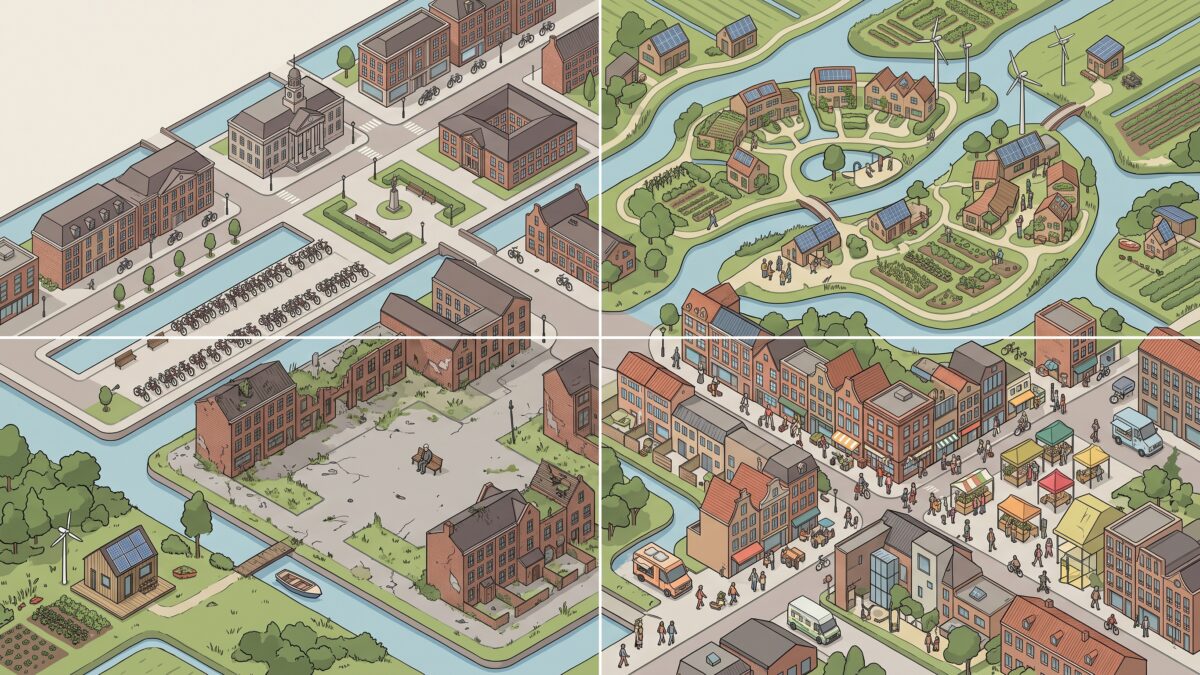
For several years now, I’ve been very enthusiastic about using socio-cultural perspectives as a framework for scenarios. This framework works well for complex societal issues and is often used for scenarios in areas like environment, sustainability, and water management. The starting point is the idea that individuals, communities, societies, and countries can be characterized by a particular perspective, or worldview. This perspective determines how they respond to change, whether economic, political, technological, ecological, or otherwise.
Group and Grid
The different perspectives can be divided along two axes, or, as Thompson et al. explain it, classified according to two dimensions of sociality: group and grid. Cultural theory distinguishes five main types of socio-cultural perspectives, though scenarios often use only three (the fatalist and the hermit are often considered too complex or too negative). According to Thompson et al.: “‘Group’ refers to the extent to which an individual is incorporated into bounded units (…) Grid indicates the extent to which an individual’s life is constrained by externally imposed prescriptions.” Below is a short description of each perspective, based on Thompson et al.
The Hierarchist Perspective
Key words: structure and stability. Hierarchists believe that people are born sinful, but can be redeemed through good institutions. This view of human nature helps sustain a way of life rich in institutional constraints. Hierarchists have no trouble setting acceptable levels of risk, as long as experts make the decision. Hierarchies instill respect for authority, as long as the right people are making decisions in the right place. For the same reason they approve of putting people and products in order, hierarchists also approve of the distinction between the public and private sphere.
The Egalitarian Perspective
Key words: harmony and solidarity. Egalitarians believe that people are born good, but become corrupted by bad institutions (markets and hierarchies). By emphasizing the risks of technological development and economic growth, egalitarians can strengthen their own way of life and undermine competing ways of life. Any system that imposes hidden, involuntary, and irreversible dangers on people cannot be trusted. Egalitarians’ warnings about looming catastrophes, such as global warming, nuclear meltdowns, and deforestation, not only let them discredit existing authority for ignoring citizens’ wellbeing, but also help reassure themselves that it’s safer inside the egalitarian group than outside it, which dampens tendencies toward fragmentation.
The Individualist Perspective
Key words: personal freedom, ambition. Regardless of institutional context, individualists believe people remain essentially the same: self-interested. For the individualist, risk equals opportunity. Without uncertainty or the possibility of loss, there would be no prospect of personal reward, and therefore no room for entrepreneurship. The long term will take care of itself; by then, individualists believe, new combinations and new technologies will emerge to soften any unforeseen consequences.
The Fatalist Perspective
Key words: comfort and pleasure. For fatalists, human nature is unpredictable. Some people may be well-meaning, but most are hostile and only push the defenseless fatalist further down. Fatalists never know what to expect from others, and respond by distrusting their fellow human beings. Fatalists don’t knowingly take risks, but others can impose unwanted dangers on them regardless. “What you don’t know can’t hurt you” is typically how the fatalist makes peace with the risks that land on them whether they like it or not. This rationalization works well for the fatalist: it lets them stop worrying about things they can’t do anything about anyway, and sometimes lends them an impressive, stoic dignity.
The Hermit / Autonomy Perspective
Key word: autonomy. The hermit deliberately withdraws from the compelling social entanglement in which the other four social types, each in their own way, are caught up. Their strategy aims at autonomy: a relaxed, unattached self-sufficiency. The hermit escapes social control by refusing to control others, or to be controlled by others. The hermit is attuned to the transforming properties of nature (and of the world in general), which makes the hermit a complex perspective to capture for many issues. That’s why this perspective isn’t often used in scenario studies.
Extreme Perspectives Make Good Scenarios
While reading this typology, you probably already found yourself associating certain countries, societies, or professions with a particular perspective. By using cultural theory as a starting point, we can develop scenarios that imagine what the world, a society, or a region would look like if a particular perspective became dominant. This helps us think through how the future might unfold, or imagine how certain “types of people” would respond to policy. In a business context, this exercise can be used to identify customer groups and come up with specific products and services.
Sources
- Original article: Silke de Wilde, “A socio-cultural framework for scenarios”, silkedewilde.com, June 10, 2013. Archived via web.archive.org
- Thompson, M., Ellis, R., Wildavsky, A. (1990), Cultural Theory, Westview Press
- RIVM (2004), Sustainability Outlook
- PBL (2010), Nature Outlook
- Offermans, A. (2012), The Perspectives Method: Towards Socially Robust River Management