

In the novel Frankenstein, Victor Frankenstein creates a new being and then turns away from his creation. The drama arises not simply because he tries to create life. It arises above all because he doesn’t think through what he then owes to his creation, to those around him, and to himself.
That question still echoes, more than two hundred years later, in the public debate about artificial intelligence. AI is not a conscious “monster,” and it’s misleading to treat technology as an independent moral agent. Yet AI systems force organizations and governments to confront a similar question: who remains responsible when a system influences decisions, evaluates people, generates information, or causes harm?
The answer can’t be “the algorithm did it.” AI systems are designed, trained, purchased, integrated, deployed, and overseen by people and organizations. Responsibility doesn’t disappear through automation; it gets distributed across a longer, more complex chain instead.
Frankenstein Is Not a Warning Against Science
Mary Shelley’s Frankenstein; or, The Modern Prometheus appeared in 1818. The novel is often read as a warning against science that goes “too far.” That’s only part of the story, though.
Victor Frankenstein doesn’t become dangerous simply because he seeks knowledge. He fails above all because he separates his ambition from care, responsibility, and forward thinking. He wants to create life, but has no plan for what should happen once he succeeds. He never asks how his creature will live, who will care for it, how others will react to it, or what consequences his experiment might have for society.
Frankenstein is therefore not an argument against innovation. The novel poses a harder question:
What do creators owe once their creation has consequences they couldn’t fully foresee?
That’s precisely the question that belongs to the current transition of fitting AI into our society. Not because AI is the same as a living being, but because AI systems increasingly shape work, education, healthcare, media, service delivery, safety, and decision-making.
AI Is Not a Monster, but It’s Not a Neutral Tool Either
AI is sometimes portrayed as an almost autonomous force that simply “happens to us.” At other times, it’s treated as a neutral productivity tool: a fast assistant for text, images, analysis, customer service, or programming.
Both pictures are too simple.
AI is not an independent moral being with its own goals, intentions, or responsibility. But AI isn’t neutral either. Every system is the result of human choices. Someone decides which problem it solves, which data it uses, which outcomes count as “good,” when a system may advise or decide, and when human intervention is needed.
An AI system that ranks job applicants, detects fraud, assesses medical images, or supports students is therefore never purely technical. It reflects choices about efficiency, risk, fairness, privacy, accessibility, and control.
The OECD points out that AI risks can include bias and discrimination, privacy problems, disinformation, polarization, and safety incidents. The specific risks vary by application, but the core issue stays the same: technical performance alone isn’t enough to guarantee responsible use (oecd).
The Chain of Responsibility
Many parties are often involved in AI. A model developer builds a foundation model. A cloud provider supplies computing power. A software vendor builds an application. An organization buys that application and connects it to its own processes and data. Employees use the outcomes. Citizens, customers, patients, students, or applicants then experience the consequences.
That makes the question of responsibility more complicated, but no less urgent.
A vendor can be responsible for technical documentation, security, and a model’s limitations. An organization that deploys the system remains responsible for choosing the application, the context in which it’s used, the data fed into it, and the protection of the people affected by its outcomes.
A useful rule of thumb, then:
Whoever uses AI to influence people, processes, or decisions cannot outsource their responsibility to the technology or to the vendor.
That doesn’t mean one person needs to oversee everything. It does mean organizations need to establish who is responsible for design choices, procurement, privacy, information security, human oversight, monitoring, complaints, and remediation.
The OECD describes accountability as an approach that ties responsibility to the full lifecycle of an AI system: from design and development through deployment, evaluation, adjustment, and decommissioning (oecd).
Four Lessons From Frankenstein for AI
1. Just because something can be done doesn’t mean it should be
Victor Frankenstein is driven by the question of whether he can create life. He barely asks what problem this solves, for whom, and at what cost.
Organizations sometimes start with AI out of technological enthusiasm, or pressure to “do something with AI.” But a better starting question isn’t: which AI tool can we use? The better question is: what problem do we want to solve, for whom, and why is AI the right approach for that?
Before deploying AI, it’s worth answering at least these questions:
- What concrete problem does this application solve?
- What alternatives exist without AI?
- Who benefits from the application?
- Who could be harmed by it?
- Which errors are acceptable, and which aren’t?
- What happens if the output is incorrect, incomplete, or biased?
AI can offer real value, for example by supporting employees, making information more accessible, or analyzing large amounts of data. But deploying the technology is not a goal in itself.
2. Design choices are value judgments
In Frankenstein, Victor is confronted with his creature’s appearance and the consequences of his own choices. He then treats those consequences as if they had nothing to do with him.
A similar risk exists with AI. Organizations can regard a system as objective because it works with data and statistical models. But a technical system also contains human choices.
Consider, for example:
- What data is used to train a model?
- Which groups are well represented in that data, and which aren’t?
- Which outcome is being optimized for?
- How heavily does speed weigh against care?
- When does an employee receive a warning?
- When does someone receive a rejection or a lower risk score?
- Can a human understand, challenge, and correct the outcome?
A system that looks efficient can reinforce existing inequality when it builds on historical patterns. A model that sounds convincing can present incorrect information. A tool that saves time can also make employees dependent on outcomes they can no longer properly check.
That’s why responsible AI use can’t just be about technical reliability. It’s also about the values built into a system, whether consciously or not.
3. Responsibility must not evaporate
AI sometimes makes decision-making less transparent. When something goes wrong, every party involved can point to another: the vendor points to the user, the user points to the software, the organization points to an employee, and the employee points to “the system.”
This is exactly where one of Frankenstein‘s most important lessons lies. A creator cannot walk away the moment their creation has uncomfortable consequences.
For organizations, this means clarifying in advance:
- Who decides whether an AI application gets deployed?
- Who checks its quality and risks before it goes live?
- Who monitors how it performs during use?
- Who can shut a system down?
- Who handles complaints, errors, and objections?
- Who communicates with the people affected?
- Who bears responsibility when remediation is needed?
The European AI Act takes a risk-based approach. Depending on the type of application, requirements may apply around risk management, transparency, technical documentation, oversight, and human control. The exact obligations are being phased in over time (ai-act-service-desk.ec.europa).
4. Think ahead about the world that emerges
Victor Frankenstein’s deepest failure may be that he never thinks about the world his creature will enter. He never asks whether the being can take part in society, how people will react to it, or what duty of care follows from that.
Something similar applies to AI. An organization can get an application working well technically and still overlook important societal consequences.
Say a municipality uses AI to process applications faster. That sounds efficient. But what happens when residents don’t understand why a decision was made? What if certain groups get flagged as high-risk more often, unfairly? What if employees trust the system’s output too quickly? And what if, over time, the organization can no longer function well without a single outside vendor?
These aren’t purely technical questions. They’re questions about trust, power, dependency, fairness, and an organization’s future room to maneuver.
This is where strategic foresight can add real value. Not by predicting exactly how AI will develop, but by exploring different possible futures and examining in time which choices remain sound.
Scenarios for AI and Society
One simple way to think ahead is to build scenarios, not to predict a single future, but to explore several plausible developments.
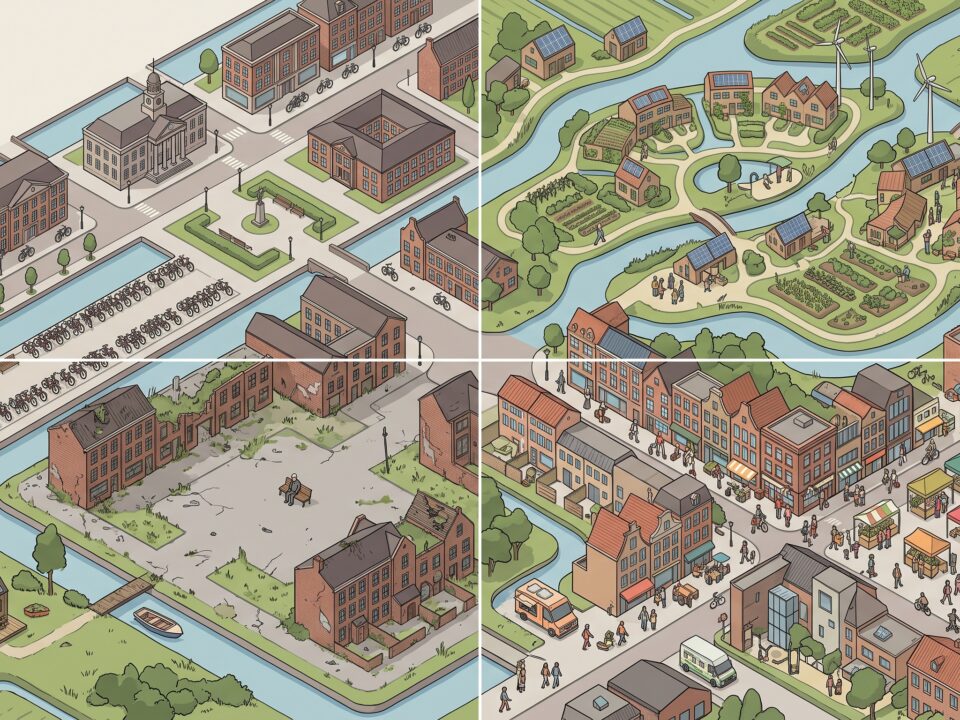
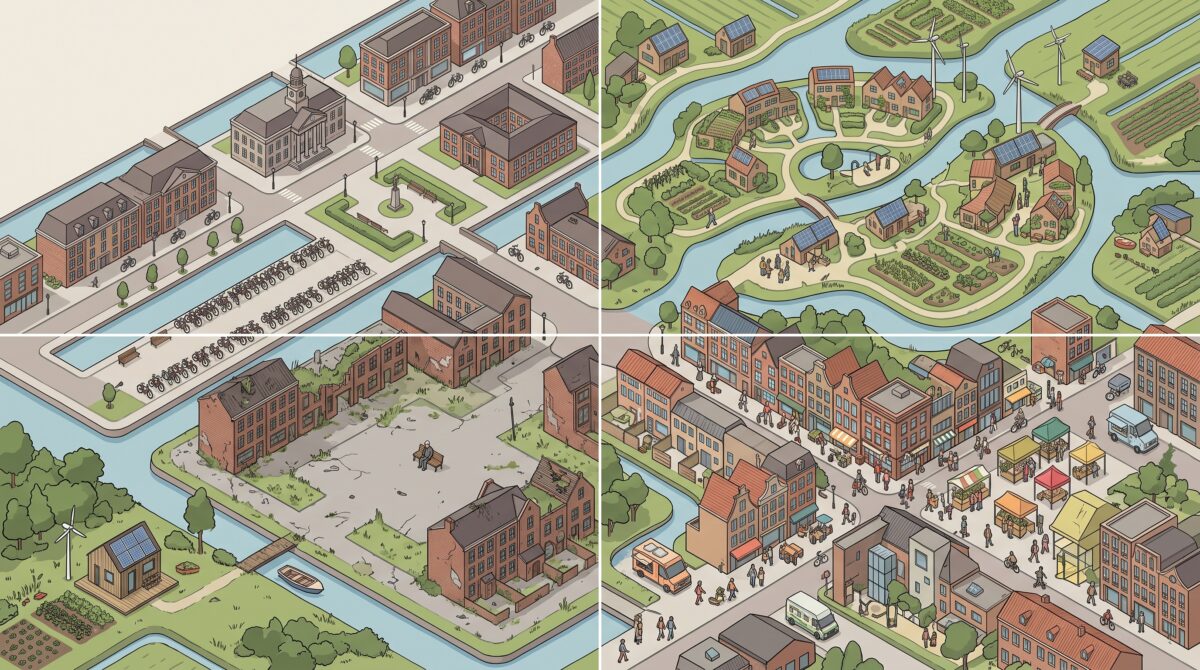
Consider, for example, four possible AI futures for an organization:
| Scenario | Characteristic | Strategic Question |
|---|---|---|
| AI as a trusted assistant | AI supports work, but people remain demonstrably accountable | What skills and controls are needed? |
| AI as invisible infrastructure | AI becomes woven into nearly every work process | Which vendors and systems are we becoming dependent on? |
| AI under strict public oversight | Rules, transparency requirements, and oversight increase sharply | How do we organize accountability, documentation, and appeal? |
| AI fatigue and loss of trust | Errors, deception, and bad experiences lead to pushback | How do we preserve trust and offer human alternatives? |
The point of scenarios like these isn’t to determine which future is most likely. It’s to discover which risks, skills, safeguards, and choices matter in each scenario.
For complex issues involving multiple parties, you can also use a form of path gaming. Have employees, customers, vendors, regulators, and executives, for example, respond to an AI incident, new regulation, or a major change at a vendor. That makes visible where interests clash and where options for action are missing.
AI Calls for More Than Compliance
The focus on AI regulation is understandable. Organizations need to know what obligations apply to them and how to manage risk. But merely meeting minimum requirements isn’t the same as using AI responsibly. The broader societal debate also touches on questions that go beyond legislation:
- How do we prevent people from losing say over decisions that affect them?
- How do we ensure AI supports public values instead of putting pressure on them?
- How do we prevent growing dependency on a small number of large technology companies?
- What human knowledge and skills do we want to preserve, even where automation is possible?
- How do we fairly distribute the benefits and downsides of AI?
The Stanford AI Index Report shows that AI development, investment, and adoption continue to grow rapidly. As a result, AI is becoming less a topic for technology pioneers alone, and increasingly a question for executives, professionals, policymakers, and citizens (hai.stanford).
The Foresight Lesson of Frankenstein
Mary Shelley’s message isn’t that people shouldn’t make new things. Frankenstein makes a harder demand: make sure curiosity, power, and technical skill come paired with responsibility.
For AI, that doesn’t mean organizations should wait until all uncertainty disappears. Innovation simply comes with uncertainty. It does mean thinking through possible consequences in advance, organizing human oversight during use, and being willing to take responsibility for repair after something goes wrong.
The question from Frankenstein therefore remains surprisingly modern:
-
Not just: what can we make?
-
But above all: what responsibility are we willing to carry for what we bring into the world?
Sources
- Mary Shelley and Frankenstein: early science fiction, science, and responsibility
- Science Fiction Prototyping
- European Commission, AI Act timeline
- OECD, AI risks and incidents