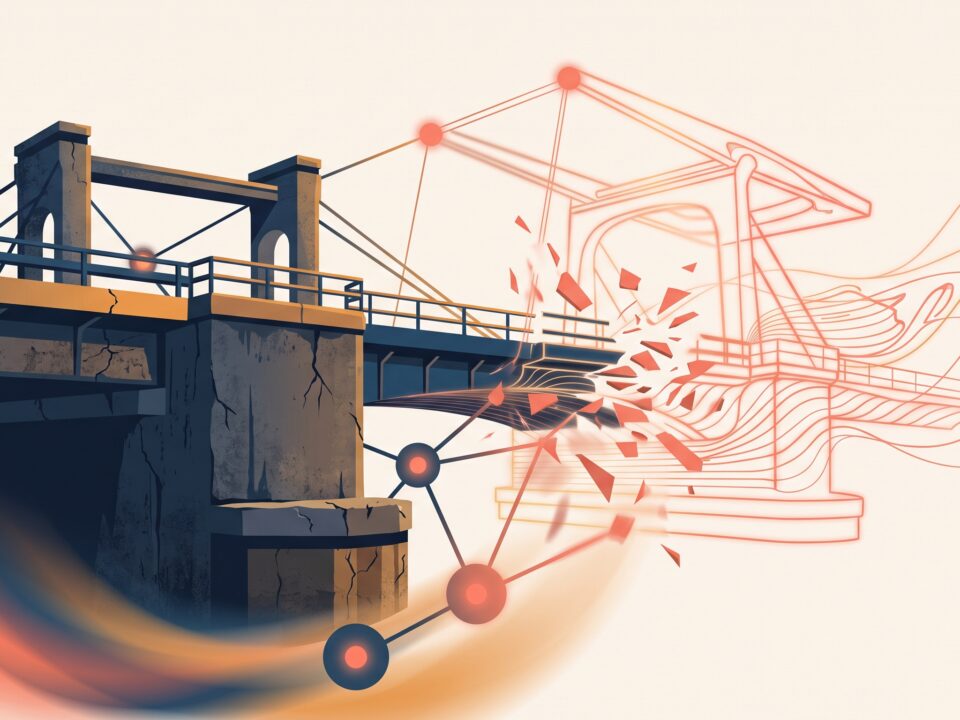



More and more organisations are investing in signal detection: dashboards, alerts, monitoring services meant to warn early when the world changes. Understandable, no one wants to be caught off guard. But a warning by itself changes nothing about how an organisation acts. Only once you’ve thought through in advance what you’d do if a particular scenario occurs does ‘finding ‘ or ‘flagging’ a signal actually give you an edge.
That’s the core lesson from a recent look by intelligence firm Dragonfly (part of Dow Jones) at how they tracked the 2025-2026 Middle East crisis. It’s a good illustration of a principle that applies just as well to a municipality, a ministry or a company: scanning for early warning signals, or an early warning system, is only valuable in combination with well thought-out scenarios.
Signals are rarely unambiguous
In practice, a crisis rarely arrives as one clear alarm signal. In reality it’s a gradual build-up: diplomatic negotiations that stall, military movements that increase, statements that get a bit sharper. Dragonfly describes how, as early as May 2025, they warned that the risk of an attack would rise if negotiations failed, and sharpened that assessment for months as more indicators came in, until the moment they issued an explicit, time-bound warning just before the first attack.
That build-up is exactly where most organisations get stuck. You don’t need a system that produces a single push-button alarm, you need a way to recognise, and dare to name, a growing pattern of weak signals before it becomes obvious.
A signal is only useful with early warning scenarios behind it
The most practical insight from the article is simple but often forgotten: early warning systems are only useful if an organisation already knows what it would do in the situation unfolding. Dragonfly therefore worked not only on warnings, but also on scenarios, for example on how a sustained American-Israeli offensive would affect airspace, shipping and evacuation options in the region. When that situation actually materialized months later, organisations didn’t have to work through that scenario for the first time in the moment itself.
That’s the difference between information and a strategic edge. A warning without a scenario still leads to ‘headless-chicken’ behavior. A warning tied to a scenario you’ve already thought through, including the question of what a next step in that scenario would signal, gives a team room to think instead of just react. This is exactly where scenario planning (currently only available in Dutch) and early warning systems need each other: one without the other is incomplete. Good early warning scenarios don’t start with the signal, but with the question of what action needs to be on the table.
What does this mean for your organisation?
A few starting points for applying early warning scenarios yourself, beyond geopolitics, too:
- Tie signal detection to scenarios, don’t treat it separately. Don’t build a standalone early warning dashboard without scenarios ready for the situations it warns about.
- Define in advance which indicators make a scenario more likely, and agree on when a build-up of signals is enough to shift to the next phase.
- Rehearse scenarios periodically. A scenario that a team experiences for the first time when it becomes reality doesn’t work as preparation, it only works once it’s already been lived through beforehand.
- Record what makes a scenario “less likely” or “more likely”, so the discussion doesn’t start from zero every time.
In closing
The biggest payoff of early warning systems isn’t the moment of the warning itself, but the time it buys you to prepare, provided that time is actually used. That requires early warning scenarios that are already in place, not ones you invent once things are already getting tense. See also our earlier blog on what early warning systems have in common in 2026 for how to recognise and combine such signals yourself.
Source
- Dragonfly Intelligence (Dow Jones), analysis of the early warning approach during the 2025-2026 Middle East crisis, “The advantage of time: delivering actionable early warning during the 2025-26 Middle East crisis”.