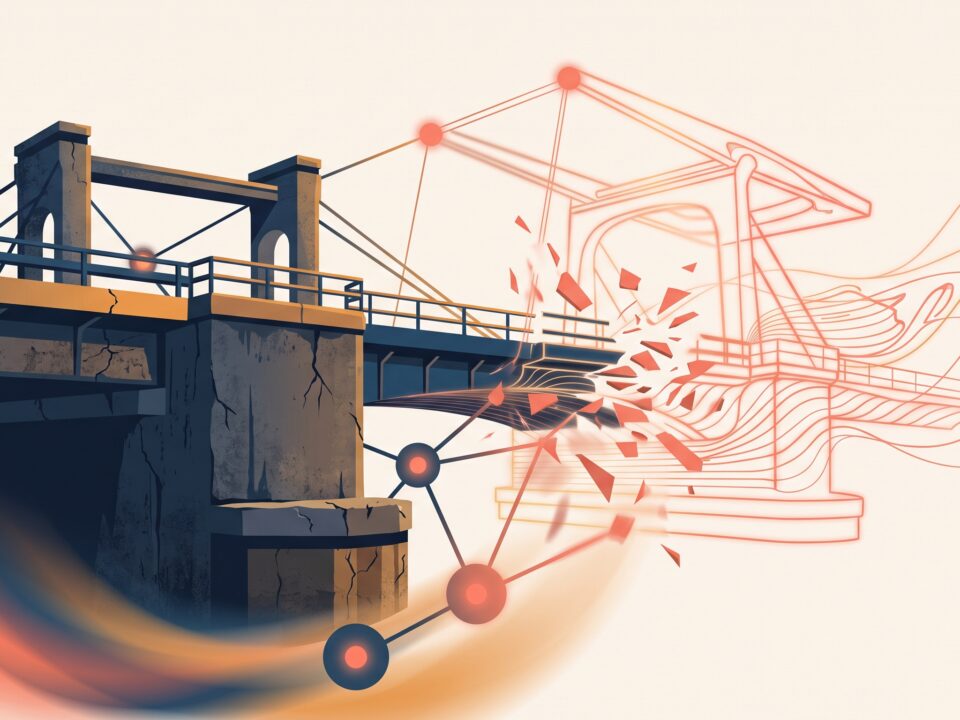


It seems so logical to plan ahead and think about the future.
Yet people struggle with long-term planning.
They fall back on short-term choices and abandon their best intentions.
This is not a lack of willpower or intelligence, but a consequence of deeper psychological mechanisms in our brain.
Understanding these mechanisms helps us comprehend why future exploration is so valuable – and how we can overcome resistance to long-term thinking.
The Brain: Designed for Survival, Not for Planning
Our brain evolved for survival in an environment full of immediate dangers, where quick reactions literally meant the difference between life and death.
The prefrontal cortex, the brain region responsible for planning and future thinking, is evolutionarily relatively young and only fully develops around age 25 (herseninstituut.nl).
This explains why especially young people have trouble with long-term planning, but the problem extends far into adulthood.
Daniel Kahneman, Nobel Prize winner and founder of behavioural economics, describes our thinking as two systems(wikipedia).
System 1 works fast, automatically, and emotionally – it helps us with daily routines and quick decisions.
System 2 is slower, more conscious, and more rational, but costs much more energy.
With future planning, we depend on System 2, but most of the time we are driven by System 1, which prefers immediate rewards over future benefits.
Present Bias: The Now Weighs Heavier Than Later
One of the most universal psychological phenomena is present bias – the tendency to prefer immediate rewards over larger rewards in the future
(insidebe.com). This mechanism, also known as hyperbolic discounting, ensures that we systematically underestimate the value of future rewards (nirandfar.com).
A classic example: most people choose €100 today instead of €120 in a month.
But those same people do choose €120 in 13 months instead of €100 in 12 months.
As soon as a choice lies further in the future, we suddenly become more rational.
This explains why we easily make good resolutions for “next week” or “next year,” but fail when the moment of action arrives.
Research by Stanford professor Walter Mischel demonstrated this in the famous marshmallow experiment (wikipedia).
Children who could wait for a second marshmallow had better life outcomes later.
Although more recent studies nuance the predictive value (bigthink.com), the experiment remains illustrative of how difficult delayed gratification is – even for adults.
Planning Fallacy: Why We’re Always Too Optimistic
Besides present bias, we struggle with the planning fallacy – the systematic tendency to be too optimistic about required time and resources.
Psychologists Kahneman and Tversky discovered that people overestimate their own capabilities and underestimate unforeseen circumstance (timemanagement.nl).
In research among students, they thought they would finish their thesis in an average of 34 days.
In reality, they needed 56 days – 65% longer than planned.
We see this pattern everywhere: from the HSL-South to personal projects.
We plan as if everything will go according to the best scenario, while reality is much more stubborn.
The planning fallacy arises because we think bottom-up from specific details instead of reasoning top-down from comparable experiences.
We imagine how smoothly this specific project will go, but forget how often previous projects overran.
Cognitive Biases: Thinking Errors That Sabotage Long-Term Thinking
Various cognitive distortions make future thinking extra difficult:
Confirmation bias ensures that we mainly seek information that confirms our existing beliefs.
In future exploration, this means we develop scenarios that align with what we already think, instead of being open to truly surprising possibilities.
Anchoring bias makes us excessively dependent on the first information we hear.
If a first future scenario is presented, it colors all follow-up discussions, making us think less creatively about alternatives.
Optimism bias leads to structural overestimation of positive outcomes.
We think that negative events will affect others before ourselves, resulting in unrealistic plans and insufficient risk preparation.
Availability bias means we weigh information more heavily the easier it is to remember.
Recent events seem more important than they are, while gradual trends are underestimated.
The Emotional Side: Why Future Thinking Feels Abstract
Thinking about the future activates different brain regions than thinking about the present (RadbouwUMC).
Neuroimaging research shows that we almost consider our future self as another person.
This explains why it’s so difficult to make sacrifices today for future benefits – it feels like we’re helping someone else.
Recent research suggests that visualizing concrete future images helps.
People who can make a vivid picture of their future life – with that career, that savings account, that healthy body – are better able to resist current temptations.
The key lies in making abstract future benefits concrete and emotional.
Practical Strategies to Overcome Resistance
Make the Future Tangible
Instead of abstract goals like “living healthier” or “saving more” for your personal goals, create specific, vivid scenarios.
Describe not only what you want to achieve, but also how it looks, how it feels, what consequences it has.
When making future explorations for organisations, you can think of scenario planning, roadmapping, and (science fiction) prototyping.
This activates emotional brain regions that normally only react to direct rewards.
Use Social Pressure Positively
Research shows that children in the marshmallow test wait much longer when they think their reputation is at stake.
Share future plans with others, make public commitments, seek accountability partners who help you with long-term goals.
This applies both to your personal development, when you discuss your goals with friends, and for organisations: when you speak with stakeholders about a future vision or scenario.
Implement ‘Future Rituals’
Create fixed moments when you systematically think about the future.
It can be a monthly strategy session, an annual scenario exercise, or a weekly moment to look ahead.
Regular practice strengthens the prefrontal cortex and makes future thinking more automatic.
Start with Small Steps
The planning fallacy suggests that we get better at realistic planning by starting with manageable projects and gradually taking on more complex challenges.
Small successes in future planning build confidence for bigger challenges.
In roadmapping, you see this reflected in formulating milestones.
Use External Tools
Because our brains have fundamental limitations in future thinking, external tools can help.
Think of scenario templates, timeline visualizations, warning systems for important trends, or software that helps with thinking through different possibilities.
The Value of Awareness
Future thinking requires more than good intentions; it requires insight into the limitations of our evolutionary brain and targeted strategies to circumvent them.
By recognising the psychological pitfalls and making the future tangible, socially relevant, and step-by-step approachable, individuals and organisations can make better long-term decisions.
This way, future planning changes from a struggle against our nature into a manageable process where human and method strengthen each other.
Sources
- Kahneman, 2011: Thinking, Fast and Slow. https://archive.org/download/DanielKahnemanThinkingFastAndSlow/Daniel%20Kahneman-Thinking,%20Fast%20and%20Slow%20%20.pdf
- Kahneman & Tversky, 1979: Intuitive Prediction: Biases and Corrective Procedures (artikel waarin planning fallacy werd geïntroduceerd). https://spsp.org/news-center/character-context-blog/planning-fallacy-inside-view
- Laibson, 1997: Hyperbolic Discount Functions, Undersaving, and Savings Policy. https://www.nber.org/system/files/working_papers/w5635/w5635.pdf
- Mischel, 1970: Cognitive and attentional mechanisms in delay of gratification (Stanford marshmallow-experiment). https://en.wikipedia.org/wiki/Stanford_marshmallow_experiment
- Arain et al., 2013: Maturation of the Adolescent Brain. https://www.ncbi.nlm.nih.gov/pmc/articles/PMC3621648/