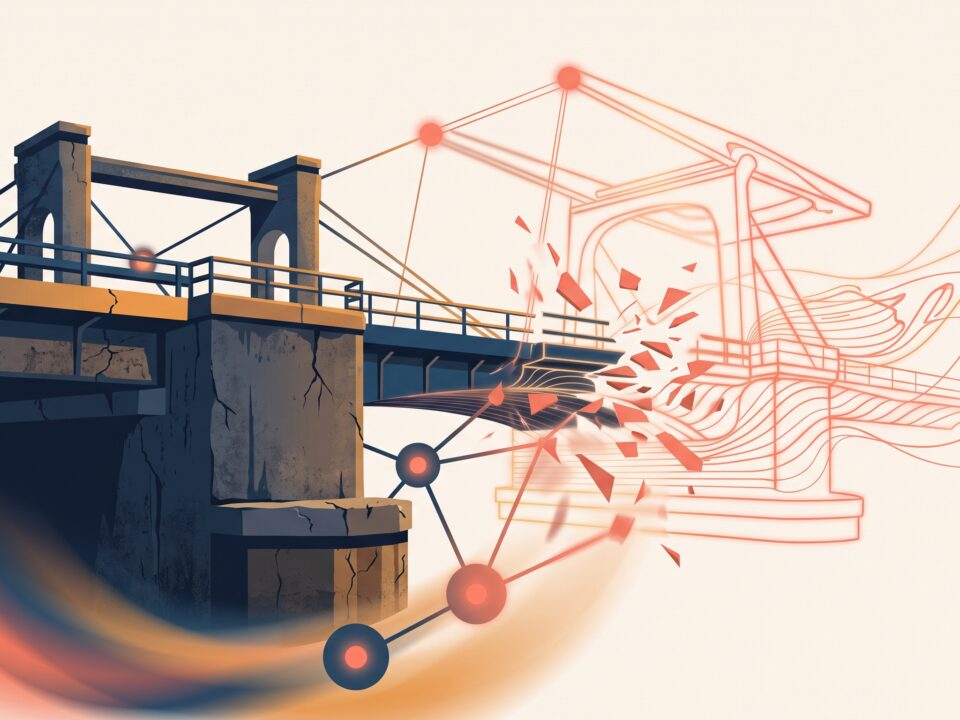



A strategic conversation about the future can set a lot in motion. People see new connections, recognise vulnerabilities and ask questions that easily slip into the background of everyday policy practice. The WRR (the Netherlands Scientific Council for Government Policy) wants to support such conversations with De toekomst in beleid. Zoeken naar zekerheden (28 September 2026). Through major shifts, relatively fixed anchor points and the tensions between them, the study helps policymakers discuss long-term issues. I think that is a valuable contribution. At the same time, reading it made me think of the follow-up question: how do we make sure it does not stop at a good conversation? A foresight study only produces change when organisations turn it into a lasting practice.
Who is the study written for?
It helps to see for whom the WRR developed this instrument. It is intended for policymakers and for conversations between ministers, policymakers and strategists, not as a handbook for professional futurists. What is a familiar principle to a futurist can be a useful entry point for a policymaker. My own question is therefore less about what is methodologically new and more about what happens after the conversation. I work out the methodological part, including how the WRR’s certainties relate to the impact-uncertainty matrix from my book Grip op de toekomst (Grip on the Future, in Dutch), in my blog in the Foresight Database (in Dutch).
The WRR names the ambition
It would be unfair to suggest that the WRR overlooks the need to embed foresight. In the final chapter the authors argue that foresight studies should not be one-off activities but a fixed part of decision-making, with well-equipped parliamentary groups, strong scientific bureaus and investment in strategic policy development. They also advise going through the step-by-step scheme several times, because new insights can put earlier steps in a different light. What remains less clear is how a policy organisation puts that ambition into practice: who keeps the analysis up to date, who monitors developments, when assumptions are revisited, and how new signals inform policy reconsideration. Early warning systems are mentioned only in the study’s reference list. This is an understandable choice for a publication focused on an analytical instrument. Still, it points to an opportunity to develop the approach further.
From separate activities to a mature practice
A foresight maturity framework helps to make that question concrete. Drawing on OECD work on strategic foresight, other literature and my own practical experience, I often use this framework that distinguishes four phases: starting, growth, integrated and advanced. Each phase is assessed across five dimensions:
- mandate and institutional embedding;
- capacity and skills;
- processes and methodologies;
- organisational culture and decision-making;
- impact and evaluation.
For me, such a framework is mainly a conversation tool. A team can be methodologically strong but have insufficient access to decision-making. Or there is administrative support, while the capacity to keep analyses up to date is lacking. It makes visible which next step is needed, and not only which method can still be added to the toolbox. The OECD describes a similar challenge as bridging the gap between foresight and policy action. The OPSI blog The Triple Challenge of Embedding Strategic Foresight in Government (2022) names three tasks: bridging that gap, building a foresight ecosystem and adapting government functions to institutionalise foresight. Orlik’s working paper (2025) names, among other things, leadership support, competences, observing trends and signals, and structures and procedures as preconditions for anticipatory governance.
Linking scenarios to a signalling and learning cycle
A practical next step is to link scenarios and policy-relevant tensions to an early warning system. This is not about predicting which scenario will become reality, but about establishing a way of working that helps identify emerging changes and discuss their policy implications in time to act. In the climate case, the WRR itself shows why that matters: anyone who only starts preparing once there is a high degree of certainty about the collapse of the AMOC will probably have too little time for adjustments in the built environment. How such a system can look in practice, I described earlier in Three Signals, One Pattern: What Early Warning Systems Have in Common in 2026 (in English). I would organise that way of working around five questions:
- Which assumptions and uncertainties determine our choices?
- Which signals can indicate that those assumptions are coming under pressure?
- Who collects and interprets those signals?
- When do we discuss whether additional analysis or adjustment is needed?
- How do these discussions feed into existing decision-making processes?
Relatively certain developments should also be part of this process. Whether a development can be considered relatively certain depends on the chosen time horizon, and that assessment should remain open to reassessment. The WRR itself emphasises that certainty depends on the timescale
A concrete addition to the WRR approach
The WRR’s shifts, anchor points and tensions provide a useful starting point for such a cycle. My addition is to embed the iterative process proposed by the WRR in organisational routines:
- give relevant questions and tensions an owner;
- name which assumptions need to be followed;
- schedule moments for reassessment;
- link the insights to policy development, implementation and decision-making;
- evaluate not only what was researched, but also what was done with it.
Not just looking ahead, but learning continuously
The WRR gives policymakers a structure for talking about the future. My plea is to build on that and also make visible how organisations can sustain that conversation and translate it into action. The question is then not only whether an organisation has produced a good picture of the future. The question is whether it keeps observing change, dares to test its assumptions and can reconsider its choices. A foresight study does not have to be the end point of a project. It can be the beginning of an organisation that learns, structurally, how to deal with the future. Sources
WRR, De toekomst in beleid. Zoeken naar zekerheden (2026)
OPSI, The Triple Challenge of Embedding Strategic Foresight in Government (2022)
OESO, Towards anticipatory governance guidelines for public sector organisations (Orlik, 2025)
Silke den Hartog – de Wilde, Grip op de toekomst (2017), chapter 4 (p. 36) and chapter 5 (p. 55)